Audubon prints from The Birds of America and The Quadrupeds of North America are in the public domain, meaning they are not subject to copyright restrictions.
As a result, they have been reproduced countless times for nearly everything one could imagine: from coffee mugs and calendars to higher quality reproductions. Although the images are nonetheless enjoyable to look at, most of these images do not hold any value beyond the enjoyment of the admirer.
There are, however, four categories of original Audubon prints, as listed below:
| Print Traits | Double Elephant Havell Edition | Royal Octavo Edition | Bien Edition | Imperial Folio- Quadrapeds |
|---|---|---|---|---|
| Date of creation: | 1827-1838 | 1840-1844 | 1860 | 1843-1848 |
| Paper dimensions: | 39.5″ x 26.5″ | 10.75″ x 6.5″ | 27″ x 40″ | 22″ x 28″ |
| Watermark: | Yes | No | No | No |
| Printing technique: | Engraving | Lithography | Chromolithograph | Lithography |
Experts use a few methods to determine if a print belongs to one of the above groups including printing technique & the characteristics of the paper. Knowledge of printing techniques can be nearly enough for some sharp eyed professsionals. However, often it is the paper that yields the answer, especially for the novice.
Watermarks and paper size are important when identifying an original. Many times, though, the print has been trimmed away and with it the correct dimensions and the watermark. In these cases, the value of the print is significantly reduced.
Measure your print and compare the dimensions with the table above.
Learn more about each of the original editions below:
Havell Edition of Audubon Prints

The first edition of Birds of America was created between 1826 and 1838 using a printing process known as engraving. Using a press which exerted a great amount pressure, the designs which were etched into copper plates were printed in black ink onto heavy paper. Afterwards, the prints were hand-colored by skilled painters using watercolors.
John J. Audubon originally created his series of prints with the assistance of master engravers Robert Havell Sr and his son Robert Havell Jr. The complete set of Havell engravings is commonly known as the “Double Elephant” folio and/or The Havell Edition. The term “double elephant” was a printers term referring to the largest paper available for printing at the time.
These engravings are the largest of the valuable Audubon prints and measure 39.5″ x 26.5″.
435 images comprise the Havell Edition and approximately 175 folios were created.
They are on J Whatman paper and bears one of two watermarks that can be difficult to see.
How to see the watermark:
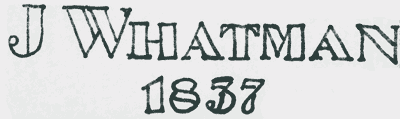
When the print is unframed, backlighting should reveal the faint mark located in the margins. Hold the print up to a lamp or other light source (not fire, of course) and the watermark should illuminate, though often very faintly.
Another method is to shine a light at an angle onto the front of the print. This can make the impression of the watermark appear with shadows.
Sometimes, the aging of the paper and/or it’s treatment through during it’s history may cause the watermark to show to the naked eye.
Over the years, many backs of the prints have been glued in the process of framing rendering their opacity nearly 100 percent and the watermark no longer visible in this manner.
Unfortunately, many original subscribers in the mid-1800’s chose to cut down the original large paper, perhaps to fit existing frames. Many times this resulted in the trimming off of the watermark. This significantly reduces the value of the Audubon print and creates a challenge to authentication.
Bien Edition of Audubon Prints

In 1858 or 1859 John Woodhouse Audubon entered upon an ambitious project, that of reproducing the Birds of America at one-half the original price, from the copper plates transferred to stone. Every plate was to be colored from the original drawings. The work was to be issued in forty-five numbers, forty-four of plates and one of text. Printed on seven double-elephant sheets, of the best quality for the purpose, 2’7 by 40 inches, each number was to contain two large plates, each occupying a whole sheet; two of medium size, each also occupying an entire sheet; and six of the smaller size, two on a sheet.
The text was to be properly and scientifically classified so that, when the work was completed, the plates could be placed and bound corresponding with the order of text, in either three or four volumes. However the work was never completed, and only one volume containing 15 numbers of 1o5 double-elephant plates with 150 species was issued. The outbreak of the Civil War, aided, it is believed, by unscrupulous dealings of business partners, resulted in disaster. The publication had been attempted in association with Messrs Roe Lockwood & Son, New York, and the lithographers J. Bien & Company also of New York.2 The lithographer, Julius Bien (1826-1909), was born at Naumberg (near Cassell), Germany. He took part in the Revolution of 1848, one of the group of notable men brought to the United States by that cataclysm. He will be remembered also as the first great scientific cartographer in the United States. During the presidency of Pierce he produced maps of the new surveys of the West. His engravings and lithographs were of the highest quality.
No copy of a prospectus prepared for American subscribers has been located. The one issued for English subscribers stated that the price of each number was to be £2 8s., or roughly $11. The forty-five numbers were to be issued for approximately $5oo, a price which was, as stated in the prospectus, half of $1,000, the price of the original work. The paper used for the publication does not have a watermark.
The personal fortunes of Mrs. Audubon were seriously affected by the failure of her son’s attempt to reproduce the Birds of America. Her older son died in 1859 and the younger died in 1862, within two years after the failure of the publication. It became necessary for the mother to raise funds in the only way left open to her, namely to try to dispose of the original drawings and the copper plates of the Birds of America. The original drawings she was able to sell to the New-York Historical Society in 1863 for $4,000.
On 19 October 1864, when she was in her 76th year, she wrote to Professor Joseph Henry, the first director of the Smithsonian Institution in Washington, in the hope that he might be able to help her sell the copper plates. In the letter the sale of the drawings is touched upon:
The sale was a sacrifice both of the Drawings and my feelings, and cruelly to state nearly the whole of the proceeds past from me soon, for the claims on notes I had indorsed for my unfortunate sons. Now I have the Copper Plates entire of the “Birds of America” which I chiefly depend on for the support of myself and orphan grand daughter.
She was not able to sell the copper plates and most of them were melted.
There is no way of knowing how many copies of the one-volume Bien Chromolithograph edition were published. During the Audubon research 49 copies were located. (See list on next page.) In 1963 a Massachusetts public library sold a copy for $2,100 and this writer knows of a copy sold to a collector about the same time for $3,000. Individual prints when offered, which is rare, are priced from $30 to $500, the latter price being that asked for the “Wild Turkey.”
Royal Octavos Edition

After the success of the Double Elephant folio (Havells edition), Audubon wanted to make a more affordable and widespread edition. This he accomplished with the Royal Octavo edition by reducing the large engravings. The name Octavo refers to the fact that the prints would be printed on paper equal to one-eighth (octave) of a full sheet of printing paper.
Begun in 1840, Audubon employed JT Bowen, a lithographer from Philadelphia, to reproduce the miniature edition.
Audubon reduced the large original engravings using a camera lucida: an artist’s tool for reducing images.
Prints from the Royal Octavo edition measure 10.5″ x 6.5″ and were originally bound into books. A total of 500 images comprise the First Royal Octavo Edition. No more than 1000 are believed to have been made.
Authenticating Royal Octavos is accomplished by measuring the print. Again, the outer dimensions should be 10.5″ x 6.5″.
Often one edge of the print bears signs of when it was originally bound and stitched into it’s book.
Imperial Folio Quadrupeds

John James Audubon is widely known and appreciated for his work with birds. But he also produced an ambitious and worthy folio of mammals. This edition was also reproduced in the smaller octavo size.
This edition was printed between 1843 and 1848.
Known as the Imperial Folio Quadrupeds, this edition was created using lithography. Coloring was done by a Philadelphia lithographer named J.T Bowen.
The paper measures 22″ x 28″.
This paper is not watermarked.
Documentation on the number of editions is not entirely clear. The first printing of full sized Double Elephant prints was 303 sets of 150 images, all sold by subscription. Later, in 1865 a second edition was created but the numbers produced is not known.